Top Signs You Need Garage Door Service – Don’t Ignore These
Most garage door failures don’t happen without warning. They announce themselves first through sound, movement and timing – a grind that wasn’t there last winter, a door that sits crooked at the floor, a close cycle that’s picked up a second or two. Homeowners tend to file those things under “just how the door is now” and move on. Then one morning the door doesn’t come up at all, and the car’s inside. If you’d rather not climb a ladder and guess, call (877) 600-5531 and we’ll take a look.
A door that suddenly takes three seconds longer to close than it did six months ago isn’t aging gracefully. Something has changed. This guide is built around that idea: the small, specific symptoms you can actually see and hear, what each one usually means, and which ones give you time to plan versus which ones mean stop using the door today.
What sounds mean what? A translation guide
Sound is the most reliable early warning a garage door gives you, and it’s also the easiest to ignore because it comes on gradually. A healthy door makes a low, steady motor hum and a soft roll of wheels in the track. Anything sharp, rhythmic or metallic is a change worth investigating. The trick is matching the noise to the mechanism, because a door is a system of springs, cables, rollers, hinges and a track, and each part fails differently.
- Grinding or a metal-on-metal rasp: usually rollers with worn bearings or a torsion spring that’s lost tension and is dragging the door. On older steel doors it can also mean dry hinges. Grinding rarely fixes itself and tends to get louder as the friction wears the parts further.
- A loud pop or bang, often followed by the door going heavy: this is the classic signature of a broken torsion spring. If a spring snaps, the door can drop fast. Stop using it and don’t force the opener. That’s a call-today situation.
- Squealing or a high whine: often rollers, hinges or the opener’s drive system asking for lubrication or replacement. Sometimes it’s the opener motor itself straining, which we’ll get to.
- Banging or shuddering: a door that jolts at the start or slam-bangs the floor at close is usually a balance or spring-tension problem. It’s putting stress on the opener every cycle.
- Clicking that won’t stop: could be a limit switch or a gear in the opener. Worth a look before the opener gives out.
In our experience, the pop-and-heavy-door case is the one homeowners most often miss. It’s loud enough that people hear it from inside the house, then assume it was “nothing.” If your door had a bang and now feels twice as heavy to lift, stop there.
Why uneven movement means a cable problem, not a track problem
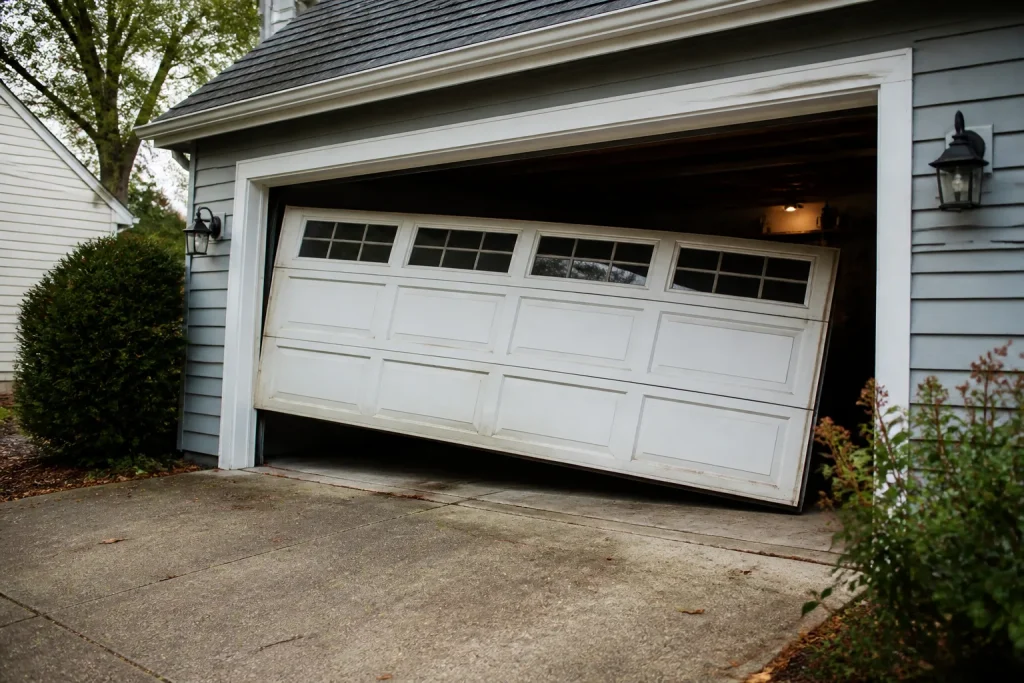
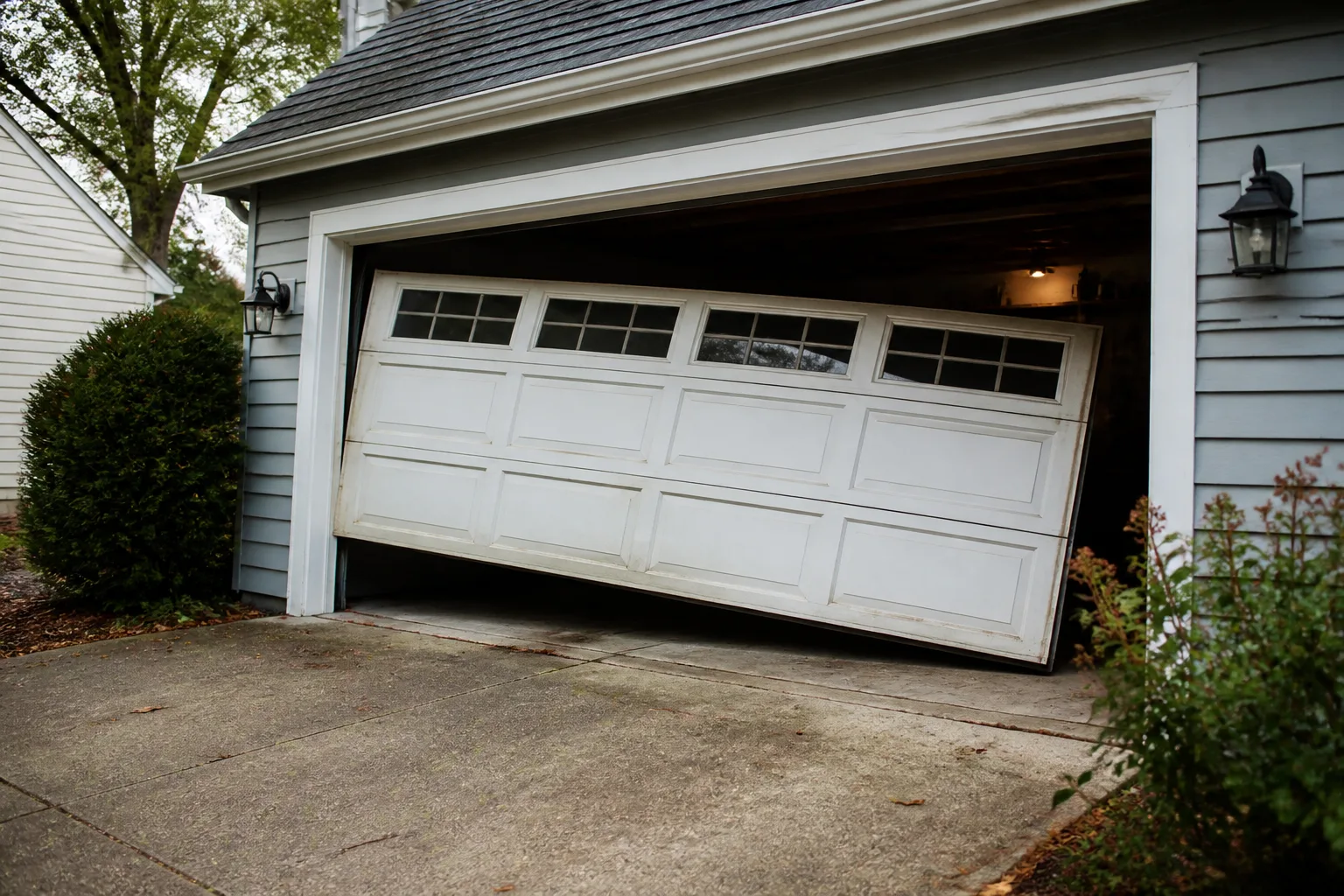
When a door closes crooked – one side touching the floor well before the other – most people look at the track and assume it’s bent. That’s the wrong first guess, and it matters. Uneven movement is usually a sign that one cable has slackened, stretched or slipped a drum, or that one spring is carrying less load than the other. The track is what the door rolls along; the cables are what keep both sides of a heavy panel moving together. If a cable is the real culprit and you try to straighten the track to “fix” it, you can leave a loose cable to snap under tension.
Cables are under extreme load and are one of the genuinely dangerous parts of a garage door to work on. Cables can whip and cause serious injury when they let go. This is not a job for a homeowner with a wrench and a video, and it’s not a job for a generalist handyman either. It’s exactly the kind of repair a specialist does: our technicians have up to 11 years of experience, and spring and cable work sits at the center of what we do. Repairing a door like this is core garage door repair work, not a side job.
A quick note on diagnosis: if the door hangs crooked and the track looks straight, suspect the cable or spring. If a roller has jumped the track entirely, that’s a different fix. Both deserve a trained eye.
The balance test: is your spring still carrying the load?
There’s one check almost any homeowner can do safely, and it tells you a lot. It’s called the balance test, and it answers a simple question: are the springs still doing their job, or is the opener now doing the springs’ work?
- Close the door fully, then pull the release cord to disconnect the opener.
- Lift the door by hand to about halfway up. It should feel manageable – a well-balanced door is one you can raise with a hand.
- Let go gently at the halfway point. A door in balance holds roughly where you left it.
- Now check the pass/fail: if it drops on its own, sags fast, or feels unusually heavy to lift, the springs are losing their lift. That’s a fail. A door that stays put or drifts only slightly is passing.
Reconnect the opener afterward by running it until it re-engages. If your door failed that test, don’t keep cycling it with the opener – the motor is compensating for weak springs and getting closer to failure. Important safety note here: this test is the “look, don’t touch” version. Never try to adjust, wind or unwind a spring yourself. Torsion springs store enormous energy and cause severe injuries when handled incorrectly. What the test tells you is whether to call, not how to fix it. Spring work done safely is a specialist’s job.
Hampton-specific accelerators: what this climate does to your door
Doors here earn their keep, and the local conditions push certain parts harder than others. None of this is dramatic, but it explains why particular symptoms show up when they do.
- Humidity and wooden panels: our summers get muggy, and wooden door panels and frames soak up that moisture and swell. A wooden door that suddenly sticks or rubs can be swelling at the edges rather than a track that’s gone bad. Come drier weather it may ease off – until it swells again next summer.
- Seasonal temperature swings and opener motor strain: a cold snap thickens lubricant and stiffens hinges, and the opener works harder to move the door. If your opener groans or struggles mostly in the cool months, that’s the door telling you the springs or lubrication are due. LiftMaster and Chamberlain openers are good at handling seasonal resistance, but they can’t out-push worn springs forever.
- Humidity on metal and hardware: damp months can rust the coils and hardware over time, adding friction and wear. If you see rust creeping along spring coils or hinges, that’s a reason to have the door checked before the friction turns into a snapped spring.
We work on the brand you already have, so whether your door is a Clopay, an Amarr or a Genie opener under the hood, we’re not guessing at the parts. This climate is hard on moving parts; the trick is catching the wear before it becomes a failure.
Watch-it or call-today: a simple priority list
Not every symptom is an emergency, and treating everything as urgent is as unhelpful as ignoring it all. Here’s how we’d sort them.
- Call today (stop using the door): a loud pop followed by a heavy door (broken spring); a door hanging crooked with a visibly loose or slack cable; a door that came off its track; a door that came down too fast or reversed unpredictably; a door left open and unsecured by a failed opener.
- Watch it, schedule within days or weeks: mild squealing, a slow-closing door that’s gained a second, small grinding, a door that’s started to sit slightly crooked but still moves evenly.
- Fix when convenient (but do fix it): a noisy wheel, a door that needs a fresh lube and tune, or a remote that’s gotten finicky.
The rule of thumb: anything involving springs, cables or a door that’s lost control belongs in the call-today column. Grinding and squealing belong in the schedule-soon column, because they usually get worse on their own. If your opener is the part behaving oddly – struggling, reversing, or clicking – that’s garage door opener repair territory, and it’s worth getting in front of before it quits. We handle emergency garage door service for the situations where you’re trapped, unsecured or stuck with a car inside, and there’s no need to wait until it’s an emergency if the warning signs are already talking to you.
The Bottom Line
Your garage door is your home’s largest moving part, and it rarely quits without announcing itself first. Listen to the grind and the pop, watch the door’s movement at the floor, and run the balance test now and then. Sort symptoms into watch-it and call-today so you’re not surprised at the worst moment. If you’re in Hampton and want a straight answer on what’s going on, Hampton Garage Door Repair Co offers free estimates – call (877) 600-5531 and we’ll tell you what we see. The written quote is the price; you’ll know the number before any work starts.
Related services in Hampton: if it’s a worn opener, take a look at garage door opener repair. If the door is past saving, garage door installation is the next step.
Frequently Asked Questions
You can’t predict it exactly, but you can tell when it’s under strain: a door that’s gotten heavier to lift, a door that fails the balance test (drops instead of holding at halfway), or a loud pop followed by a heavy door all point to a spring past its limit. If you see rust creeping along the coils, that’s more reason to check.
Uneven movement – one side hitting the floor before the other – is usually a cable or spring problem, not a bent track. The cables keep both sides moving together; if one slackens, the door closes crooked even though the track looks fine. That’s a call-today symptom because cables are under extreme tension and can cause serious injury. Don’t try to fix it yourself.
Yes, the balance test is safe as long as you only lift, release and look. Disconnect the opener, lift the door to halfway, let go gently. If it holds, the springs are carrying the load; if it drops or feels heavy, they’re not. Never try to adjust or unwind a spring yourself – that’s the dangerous part, and it belongs to a trained professional.
Call for anything involving springs, cables, a door off its track, a door that’s lost control, or an opener that won’t respond. Schedule rather than ignore the squealing, grinding and slow-closing symptoms, because those get worse. Our technicians have up to 11 years of experience, and we handle repair, opener work, springs and installation as a single-trade specialist.
Written by the team at Hampton Garage Door Repair Co.
Need Garage Door Help?
Call Hampton Garage Door Repair Co - the local pro we connect you with is licensed and insured, here with fast after-hours help in Hampton.
(877) 600-5531